
The Ethical-Reflexive Engagement Model
~ More aware. More responsible. More human. Practitioners ~
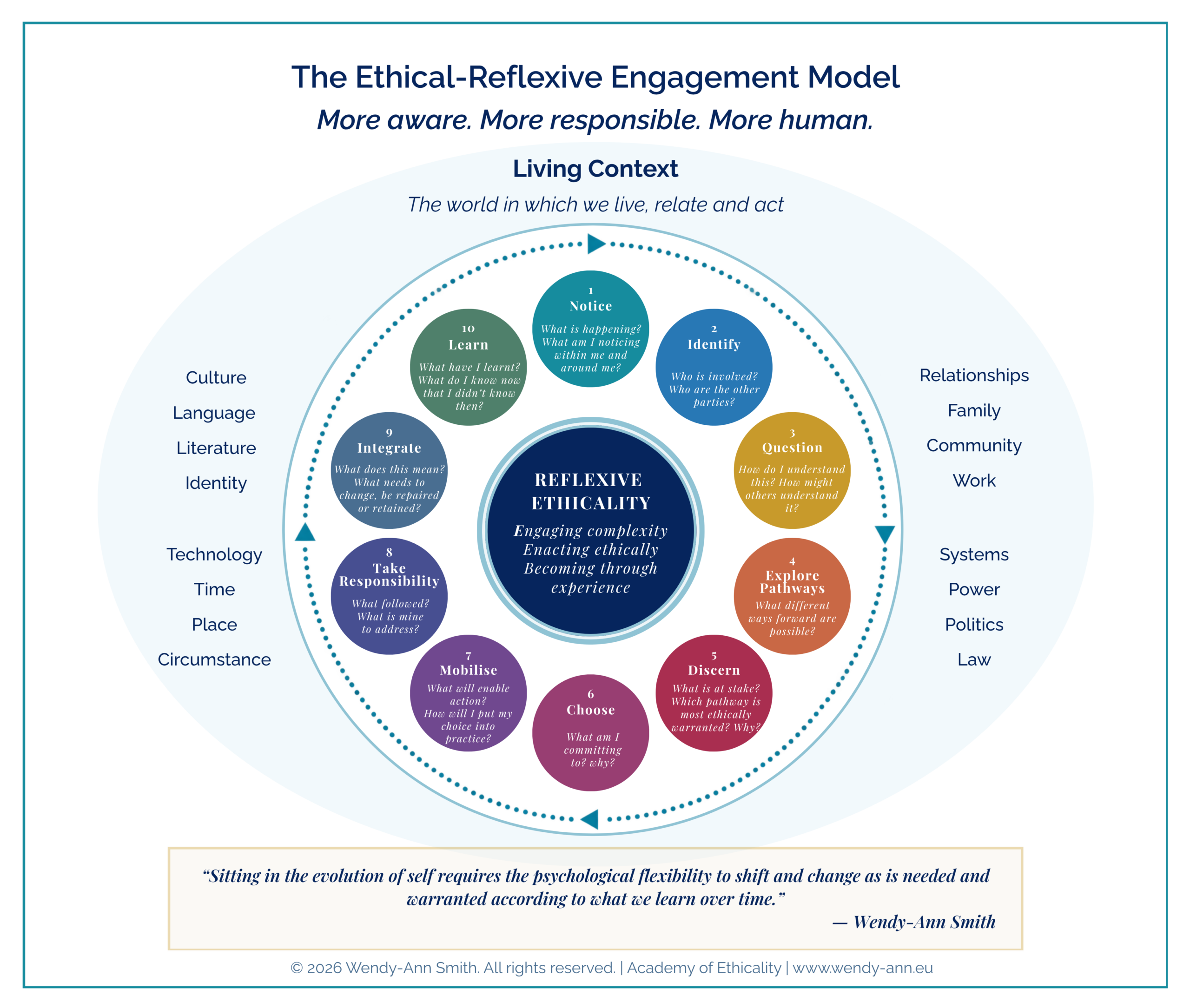
Ethical-Reflexive Engagement Model
The Ethical-Reflexive Engagement Model is a practitioner model for engaging ethically and reflexively in the situations, choices and decisions that arise through professional and relational life.
It offers a way of attending to how we engage: what we notice, who and what we take into account, how we question our understanding, explore possible pathways, discern and choose, and how we translate those choices into action. Importantly, engagement does not end with action. The model also brings attention to responsibility for what follows, the integration of experience, and what we learn and carry forward.
At its centre is Reflexive Ethicality: engaging complexity, enacting ethically and becoming through experience.
The model brings together ten movements of ethical-reflexive engagement. These are not intended as a rigid sequence or checklist. Depending on the situation, we may move backwards and forwards between them, remain with one movement for some time, or return to an earlier question as our understanding develops.
The Ten Movements of Ethicality
The ten movements provide different points of attention within ethical-reflexive engagement. While they are represented in a particular order, ethical engagement is rarely linear. We may move between movements, revisit earlier ones as something new becomes apparent, or discover through action that further questioning or discernment is needed.
1. Notice
~ What is happening?
~ What am I noticing within me and around me?
Notice brings attention to what is occurring before we rush to interpretation or action. It includes what we observe around us as well as our own thoughts, emotions, bodily responses, assumptions and impulses.
involved?
2. Identify
~ Who is involved?
~ Who are the other parties?
Identify widens attention to the people and other parties involved or affected. It asks us to consider not only those immediately present, but also those whose interests, perspectives, responsibilities or wellbeing may be implicated.
3. Question
~ How do I understand this?
~ How might others understand it?
The questions turn attention towards interpretation and perspective. It invites us to examine how we make sense of what is happening, what assumptions may be shaping that understanding, and how others might understand the situation differently.
4. Explore Pathways
~ What different ways forward are possible?
~ What possibilities have I not yet considered?
~ What might become possible if I looked at this differently?
Explore Pathways opens up possibilities before commitment. Rather than moving immediately towards the most obvious response, it invites consideration of different actions, conversations, pauses and ways forward.
5. Discern
~ What is at stake?
~ Which pathway is most ethically warranted? Why?
Discern brings the possibilities into deeper consideration. It involves attending to what matters, what may be gained or lost, who may be affected, and what is ethically warranted under the circumstances.
6. Choose
~ What am I committing to?
~ Why?
Choose moves from consideration towards commitment. It asks us to take responsibility for the path we choose and to explain why we chose it.
7. Mobilise
~ What will enable action?
~ How will I put my choice into practice?
Mobilise moves from intention to action. It asks what will enable us to enact our choice, including the resources, relationships, courage, preparation, or support we may need.
8. Take Responsibility
~ What followed?
~ What is mine to address?
Responsibility continues beyond the decision or action itself. This movement asks us to attend to what followed, including consequences we anticipated and those we did not, and to consider what is ours to acknowledge, respond to or repair.
9. Integrate
~ What does this mean?
~ What needs to change, be repaired or retained?
Integration involves making meaning from what has occurred. It asks what the experience changes, confirms, or unsettles, and what we need to incorporate into how we understand ourselves, others, and our practice.
10. Learn
~ What have I learnt?
~ What do I know now that I didn’t know then?
Learning turns experience into something that can inform future engagement. It asks what has become newly understood and what we now carry into subsequent situations, choices, and relationships.
Living Context
Ethical-reflexive engagement does not occur in isolation. Living Context recognises that how we understand, discern, and act is continually shaped by the relational, cultural, social, systemic, and situational world in which we live, relate, and act.
Reflective Question Guide
A companion Ethical-Reflexive Engagement Reflective Question Guide is currently in development. It will expand the ten movements through a broader set of reflective questions designed to support individual reflection, dialogue, supervision and facilitated inquiry.
Reflective Question Guide — forthcoming.
Intellectual Development and Provenance
The Ethical-Reflexive Engagement Model forms part of my continuing work on ethicality as a lived, developmental and relational human capacity.
The model builds upon ideas developed through Courageous Becoming, including attention to context, intentional agency, discernment, action, responsibility, learning and becoming through experience. It develops this work into a practitioner model focused specifically on how we engage ethically and reflexively as situations unfold.
The model also sits within the broader domain of Developmental Ethicality, which examines how ethical capability develops within individuals, relationships, cultures and systems over time.
Courageous Becoming: Cultivating Ethicality
Smith, W.A. (2025). Courageous Becoming: Cultivating Ethicality. Journal of Coaching Ethics, 2(5). https://doi.org/10.62882/47adx108
Courageous Becoming — Explore the model
The Praxis Model — Explore the model
Developmental Ethicality — Explore the domain.
© Wendy-Ann Smith, 2026